

A business plan’s executive summary must make the full plan easier to assess, not simply sound polished. A business plan executive summary generator turns your business details into a concise draft, often designed to fit 1-2 pages, and can also summarize key information for reports.
An AI business plan executive summary generator can save time on a first draft, but the result still needs your judgment. It can organize the problem, proposed solution, business model, and financial outlook. You provide the real figures, evidence, and decisions that make the summary credible.
Learn what an AI business plan generator does, how it creates executive summaries for plans and reports, and what to review before using a draft. You’ll also see how a summary fits into a complete business plan, helping you move from a blank page to a clear, decision-ready document.
Key Takeaways
- See how AI can turn business inputs into a structured plan, and why the right version depends on whether you’re planning internally or preparing an application.
- Learn how to shape summaries for business plans and reports, then compare each draft with its original figures and evidence.
- Identify the information an executive summary needs to help readers quickly understand the opportunity, business model, and financial outlook.
- Explore how a clear summary connects to the wider plan, including its forecasts, milestones, and supporting sections.
What is an AI business plan generator?
A business plan executive summary generator turns business information into organized plan sections and a concise overview. Choose a format suited to the document’s purpose, then check that its analysis and forecasts reflect your actual business.
Investor and Lender Use
For investors, prioritize an investor-ready format that connects the opportunity, market analysis, business model, and financial projections. The summary should make the funding request and business case clear, while the plan’s supporting sections show how the numbers connect to operations. A forecast can use a 6-36-month horizon, depending on the planning needs.
For a small-business loan or grant application, use a bank- or loan-focused plan mode, then adapt the output to the lender’s template. Investors and lenders assess a plan’s substance, not whether AI helped draft it. For internal planning, focus on milestones and forecast assumptions; for a pitch, align the summary with the presentation. A lean plan can be 1-2 pages, while a standard format gives more room to develop the business.
Free and Paid Generator Options
What are the best free business plan executive summary generators? The right fit is a tool that helps structure the opportunity, market analysis, and financial projections for your intended reader. Compare how clearly it organizes the content and whether you can adapt the draft for a report, internal plan, or investor pitch. Check all generated figures against your own inputs.
How much do paid business plan generators cost? Pricing varies with the scope of the output, such as whether it includes a full plan, financial forecasts, or a presentation alongside the summary. Compare the documents and planning tools included, not just the summary format. A free draft can help shape an idea; a fuller plan can provide supporting detail for investors, lenders, or grant applications.
AI-generated executive summaries for business plans and reports
AI can shape the business details you provide into a summary for a plan or report. Treat the draft as a starting point, then align its claims, format, and visuals with the source material.
Reviewing and Validating Generated Plans
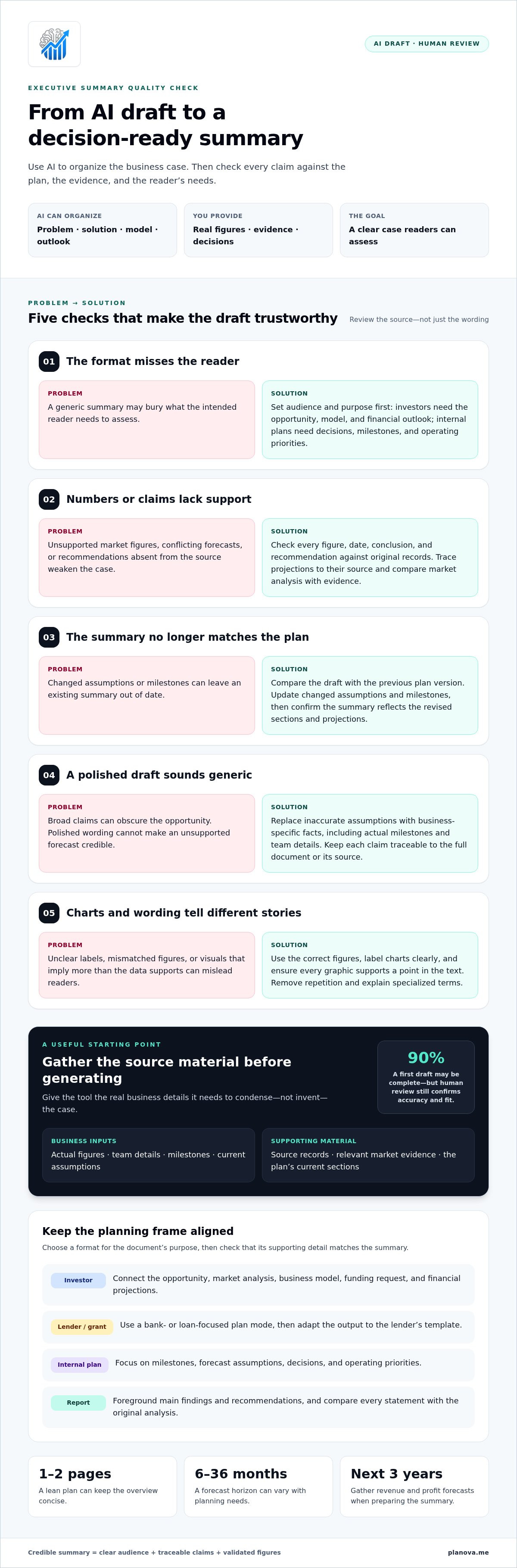
Check every figure, date, conclusion, and recommendation against the original records. Trace projections to their source and compare market analysis with supporting evidence before presenting the opportunity. Replace inaccurate assumptions with business-specific facts, including actual milestones and team details. Polished wording cannot make an unsupported forecast credible.
For an existing plan, compare the draft with the previous version. Update changed assumptions and milestones, then confirm the executive summary reflects those revisions. Make data visualizations easier to read by labeling charts clearly, using the correct figures, and ensuring each graphic supports a point in the text.
Editing and Presenting Generated Plans
Tailor the format to the reader. An investor-focused business plan summary should connect the opportunity, business model, and financial outlook. A report summary should foreground its main findings and recommendations. Keep each claim traceable to a section or source in the full document.
Before you present, edit for clarity and consistency. Remove repeated claims, explain specialized terms, and check that chart labels match the written figures. An AI-generated first draft may be 90% complete, but human review still needs to confirm its accuracy and fit.
Avoiding Executive Summary Mistakes
What mistakes should you avoid in a business plan executive summary? Don’t include market figures without evidence, forecasts that conflict with the financial model, or recommendations absent from the source. Avoid broad claims that obscure the actual opportunity, and make sure visualizations don’t imply more than their figures support.
For a report, compare every summary statement with the original analysis before sharing it. For a business plan, match the summary to the current plan sections and financial projections. If you’re developing a complete plan alongside its summary, explore structured business plans as a way to keep the documents aligned.
Definition and purpose of an executive summary
An executive summary condenses a larger business plan into a concise overview of its opportunity, model, and financial outlook. It helps readers grasp the central case before they review the full document.
Audience, Tone, and Purpose Prompts
Set the audience and purpose before generating a draft. For investors, ask for an overview that foregrounds the opportunity, business model, and returns. For internal planning, prioritize decisions, milestones, and operating priorities. Specify a professional, direct tone and identify the source document the summary should reflect.
That prompt gives the tool a clear frame instead of a generic summary. Gather actual business figures, team details, milestones, and supporting evidence first. Include revenue and profit forecasts for the next 3 years, then tell the generator which metrics matter most to the intended reader.
Executive Summary Contents
A business plan summary may cover the problem, proposed solution, target market, business model, and financial outlook. Include the evidence behind the opportunity and the metrics that support its commercial case. Keep recommendations consistent with the plan, rather than adding claims its underlying sections cannot support.
How do you write a business plan executive summary step by step? First, identify the reader and purpose. Next, gather the business’s actual figures, milestones, team details, and evidence. Draft the core opportunity, solution, model, and financial outlook, then compare every statement with the full plan and revise for clarity.
Before generating a summary, gather source figures and relevant market evidence alongside the plan’s current assumptions. This gives the tool material to condense and helps distinguish established facts from projections.
Business Plan Summary Length
How long should an executive summary be in a business plan? A common target is 1-2 pages, though summaries can range from one paragraph to two pages. The right length depends on the plan’s scope and the detail needed to explain its case.
Another useful measure is proportion: an executive summary is usually 5-10% of the original document. Cut background that doesn’t advance the decision, but retain the metrics and context needed to understand the opportunity. A concise summary should still make sense without forcing readers to guess what the figures mean.
AI-generated executive summaries and business plan sections
An executive summary works best as a connected view of the business plan, not as a standalone sales pitch. AI can draw on sections such as market analysis, operations, and financial projections, then show how they support the same opportunity. The key is preserving the links between claims, assumptions, and evidence.
Start with the source sections you want summarized. For example, connect the target market and customer problem to the product’s value, then link the business model to revenue projections. If the market analysis describes one customer group but the forecast assumes another, resolve that mismatch before generating a summary. The reader should see one coherent case.
A template can guide the structure, but it shouldn’t dictate unsupported claims. Give the generator the current plan, intended reader, and points to emphasize. Ask it to summarize each section, then compare the result with the original. This helps you spot a missing operational detail, a changed assumption, or a projection that no longer matches the financial model.
Use the draft to surface connections, not to replace your judgment. The market opportunity should align with the proposed solution, the solution should fit the operating plan, and the projections should reflect those choices. For example, if the plan describes gradual customer acquisition, its revenue forecast should tell a compatible story. Revise the relevant section before finalizing the summary.
For a complete document, review the summary beside the full business plan and its supporting sections. A structured business plan draft can help bring those elements together, while your review keeps every claim tied to the plan’s actual assumptions.
Planova: Business Plans
Planova helps entrepreneurs turn business information into structured plans and supporting materials. Its AI-powered platform generates business plans, feasibility studies, and financial forecasts, giving you a foundation for developing and refining your executive summary.
Use Planova when you need a complete plan rather than a summary alone, or when the summary must align with forecast assumptions and supporting sections. Planova also generates Excel financial models and pitch deck presentations to help organize the numbers and communicate the business case across key documents. Review generated content against your actual figures, milestones, and evidence before presenting it.
Ready to build a plan around your business inputs? Visit Planova to explore the tools.
Put the next decision in motion
Make the summary useful beyond the document by choosing a decision it should support, such as refining a market entry, adjusting an operating assumption, or aligning the team around a priority. A business plan executive summary generator can speed up the draft, but your next decision gives it direction.
Turn that decision into a practical review. Identify who needs to act, what evidence they need, and which assumption deserves attention first. Set a clear next step, such as updating the underlying plan or preparing a focused team discussion. This keeps the summary connected to real work instead of making a polished document the finish line.
As your priorities develop, revisit the summary whenever the business case or direction changes. Keep it tied to the decisions ahead, and let it guide purposeful progress. Contact Planova about your business plan to explore a next step. Move forward with a clear focus and a plan you can act on.
Frequently Asked Questions
Can an AI really write an executive summary that sounds professional?
Yes. AI can produce a polished draft, especially when you provide clear business details and define the audience. To make it sound like your business, replace generic phrases with specific product, customer, and operating details. Describe the customer problem in the language buyers use, then ensure the summary’s claims match the rest of your materials.
Do I need business experience to use this?
No. You can start with what you know about your idea, intended customers, and how the business will operate. The result improves when you can explain key assumptions, such as how customers will discover the product or what drives sales. Treat unfamiliar concepts as prompts to gather information, not as reasons to accept an unclear draft.
What should a business plan executive summary include?
Include the business’s identity, the customer need, your solution, and what makes the approach distinct. Add the intended market, how the business earns revenue, key milestones, and the plan’s purpose. For example, if you’re seeking support for a product launch, explain what the funding would help accomplish and connect that use to a specific business objective.
How do AI executive summary generators compare with business plan templates?
A template provides a preset structure for entering information, while an AI generator can turn your inputs into connected prose. Templates make expected sections visible; AI can adapt the wording to a particular reader or purpose. You can use both by drafting with AI, then checking the result against the template’s required headings and order.
Can an AI-generated executive summary be used for SBA loans or investors?
An AI-generated summary can be a draft for either audience, but it should match the full application or pitch materials. For an SBA loan, adapt the business plan to the lender’s template and keep supporting figures consistent. For investors, connect the opportunity and business model to the evidence and projections in the plan.
How do I tailor an executive summary for investors, lenders, or grant applications?
Start by identifying the reader’s decision. Investors need a clear view of the opportunity, business model, and potential returns. Lenders need a coherent account of the business and its ability to support repayment. For a grant application, connect the proposed work to the application’s stated goals, then use consistent evidence and milestones throughout the summary.

