

An AI business plan generator can use your company inputs to draft market analysis, strategy, and financial forecasts, then give you a plan to refine. You can customize the tone, structure, and formatting so the document fits your business and its purpose. Drafting and refining an AI-generated plan can take 15 minutes to a few hours, depending on the work involved.
An AI business plan generator can produce a fast first draft, but your judgment still matters. Your assumptions, customer knowledge, and business goals determine whether the plan feels specific and its financials make sense.
Learn what information to provide, how AI turns it into a business plan, and what to review before using the document. We’ll cover market analysis, strategy, financial projections, tone and formatting, and how to turn a generated draft into a practical plan.
Key Takeaways
- Separate useful AI-generated structure from assumptions that need your own business knowledge and evidence.
- Assess whether market analysis and strategy reflect your customers, competitors, and operating model.
- Trace financial projections back to their underlying sales, expense, and growth assumptions before relying on them.
- Turn a reviewed draft into a clear working document, or use Planova’s business planning tools to develop it further.
AI-generated business plans
AI-generated business plans turn your inputs into an organized draft for review. The National Center for Biotechnology Information describes generative AI as creating content from trained parameters.
AI Plan Drafting
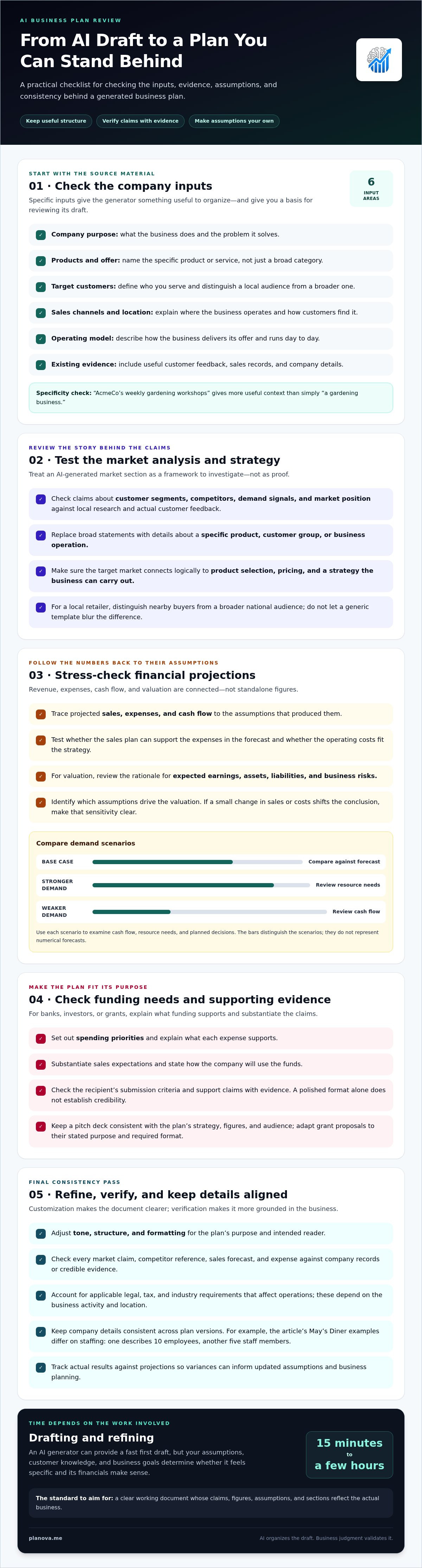
An AI business plan generator uses company inputs to draft a structured plan. Those inputs can include the offer, target customers, location, and operating model. Drafting and refining a plan can take 15 minutes to a few hours. For a local retailer, enter its neighborhood, products, and ideal customers, then revise broad claims. Talk To Plan lets you request edits conversationally, such as a clearer section or adjusted tone.
Funding Plans for Banks, Investors, and Grants
Plans for banks, investors, or grants should connect funding to business needs. Set out spending priorities and explain what each expense supports. Substantiate sales expectations and state how the company will use the funds. Lenders and investors may accept AI-generated plans if they meet submission criteria and support their claims with evidence. A polished format alone does not establish credibility. Keep the pitch deck consistent with the plan’s strategy, figures, and audience. Adapt grant proposals to their stated purpose and required format.
AI Plan Limitations
AI can organize the information you provide, but it cannot make unsupported assumptions reliable. Check every market claim, competitor reference, sales forecast, and expense against company records or credible evidence. Replace generic statements with details about a specific product, customer group, or business operation. A U.S. plan should account for applicable legal, tax, and industry requirements that affect operations. These depend on the business activity and location, so reflect their impact in the plan’s assumptions. Review the final draft for consistency before sharing it.
AI-drafted market analysis, strategy, and financials
AI can bring market assumptions, strategic choices, and financial projections together in one draft. Review how each conclusion follows from the business information you provided.
Market Analysis Drafting
A market analysis draft can organize customer segments, competitors, demand signals, and the company’s position. Treat a template as a framework, not evidence: strengthen its claims with local research and actual customer feedback. For example, a neighborhood retailer should distinguish nearby buyers from a broader national audience. Then connect that target market to product selection, pricing, and a strategy the business can carry out.
Valuation and Financial Planning
Financial planning turns strategy into linked assumptions about revenue, expenses, and cash flow. These figures show how projections depend on operating costs and sales targets rather than standing alone. Test whether the sales plan can support the expenses in the forecast.
Valuation also depends on assumptions, including expected earnings, assets, liabilities, and business risks. An AI draft can organize these inputs, but any estimate needs a clear rationale. Compare the valuation with the underlying forecast and identify which assumptions drive the result. If a small change in sales or costs shifts the conclusion, make that sensitivity clear in the plan.
Use financial forecasting and modeling to compare a base case with stronger or weaker demand. Review how each scenario changes cash flow, resource needs, and planned decisions. Reporting should then track actual results against projections, so owners can spot variances and refine business planning. Explore scenario-based financial planning to structure those assumptions for review.
Business idea description and company inputs
A useful business description names the offer, the customer, and the problem it solves. Give the generator a specific concept, such as AcmeCo’s weekly gardening workshops, rather than simply “a gardening business.” That detail helps connect the idea to customers, operations, and revenue assumptions.
Organize your input into clear sections: company purpose, products, target customers, sales channels, location, and operating model. For a local retailer, describe the neighborhood, core products, and how shoppers find the store. Add evidence you already have, such as customer feedback or sales records. Specific inputs give the generator useful material to organize and refine.
AI business plan generators do not share one standard price. Costs depend on the product and may be provided after a quote request; factors can include features, document outputs, and customization. Compare the workflow and deliverables you need, not just the initial access terms. Do not assume two tools offer the same scope.
Free access and trials vary by product. Before building a full plan, find out what each option lets you create, edit, and export. A short test using the same concept and company information makes comparisons more useful. Check whether the resulting sections suit your intended professional business plan.
Compare generators by what they produce from your inputs. Check whether they organize market, operations, and financial sections, and whether you can revise the draft. Then try the same prompt in ChatGPT and a dedicated generator. ChatGPT can help develop individual passages through conversation; a specialized workflow may organize content around business-plan sections.
Traditional planning often starts with a blank document and a structure you build manually. A generator can provide a first framework, but you must supply accurate details and correct unsupported claims. Judge the result by how well it reflects the business concept, connects decisions across sections, and communicates clearly to its intended reader.
For example, the Starter Plan example describes May's Diner as having 10 employees and being located in Atlanta, Georgia. The Professional Plan example describes May's Diner as having five staff members. Keep the company details aligned across plan versions, and check that staffing and location are described consistently wherever they affect the business description and operating assumptions.
Business plan customization
Tailor the draft to your mission, audience, and business model. A neighborhood bookstore, for example, may emphasize community events and repeat customers, while an online retailer may focus on fulfillment and digital sales. Match the tone to the reader: use direct, operational language for internal planning, or concise, evidence-led language for a funding discussion. Keep the core facts consistent across versions.
Adjust the section order and level of detail to suit the plan’s purpose. Entrepreneurs creating an internal roadmap may prioritize milestones, staffing, and daily operations. Owners presenting to a lender may lead with funding needs, repayment logic, and financial assumptions. Update headings and examples to reflect the business while keeping its mission and supporting evidence aligned. A clear format makes priorities easier to find without changing the substance.
Genuine, relevant customer testimonials can add perspective. Choose comments that illustrate a specific benefit, such as helpful service at a retailer or the practical value of a product. Attribute each quote accurately and get permission before including identifying customer details. A testimonial alone does not prove market demand. Pair it with sales records, customer research, or another relevant source.
Useful customer support helps users resolve practical issues, such as clarifying an input, correcting a section, or understanding a document’s layout. Keep a short revision list with the section, requested change, and reason. For example, note that the target customer description needs to reflect local buyers, not a national audience. This makes edits easier to communicate and review. Shape a business plan around your model and the audience it needs to serve.
Planova: Business Plans
Planova helps turn company inputs into business documents for planning and evaluation. Its software generates business plans, feasibility studies, financial forecasts, Excel financial models, and structured pitch deck presentations. Use it when you need to move from a reviewed draft to organized materials that support strategic decisions, assess an idea, or present the business clearly.
Choose the document that fits your next task. A business plan brings the strategy together; a financial model lays out forecast assumptions; a feasibility study helps evaluate a proposed concept; and a pitch deck presents the opportunity concisely. Keep source information consistent across documents so their story and assumptions align.
Explore Planova at planova.me and choose a practical next step for your plan.
Put your next business decision in motion
A plan is valuable when it helps you decide what to do next. Use the draft from your AI business plan generator as a decision tool: identify the assumption that matters most, decide what evidence would strengthen it, and set a practical next step. That turns the document into a working reference for your business.
When you’re ready to develop your material into a polished set of documents, Planova offers business plans, financial models, and pitch decks. These formats help organize your strategy, make financial assumptions easier to review, and present your business clearly.
Start shaping your plan with the right support for your next milestone. Contact Planova to discuss your plan, and move forward with a clearer direction.
Frequently Asked Questions
Can I customize the tone and formatting?
Yes. Specify the intended reader and style, such as a concise, formal plan for a lender or a plain-language working document for your team. You can also request clear section labels, short paragraphs, and consistent terminology. After generation, check that the headings, voice, and business details remain consistent across the executive summary and full plan.
Can I use this to create an investor pitch deck?
Yes. Planova generates structured pitch deck presentations that summarize a business model, market opportunity, and key metrics. Use the plan’s central claims to shape the slide narrative, then check that the deck matches the supporting financial assumptions. For example, keep the customer problem and revenue logic consistent from the opening slides through the financial summary.
Do I need financial expertise to use this?
You don’t need formal financial expertise to start a draft, but you do need to understand the assumptions you enter. Check how expected sales connect to expenses, cash flow, and hiring decisions. If the forecast uses unfamiliar terms, clarify their meaning before relying on the output. Generated financial projections are not accounting or tax advice.
Does it work for non-tech businesses?
Yes. A business plan can describe a service company, local shop, or other non-tech venture, as well as a software startup. For a home-cleaning business, for example, explain the service area, customer type, booking process, staffing approach, and recurring costs. Concrete operating details help the plan reflect how the business earns revenue.
How is this different from downloading a PDF template?
A PDF template gives you a fixed structure to complete manually. A generator uses your inputs to draft content across relevant sections, which you can then edit. For example, a template may prompt you to describe marketing, while a generated draft can organize your specific customer acquisition approach. In either case, review the details before sharing the finished plan.
What information should I include in my prompt?
Describe what you sell, who buys it, the problem it solves, and how customers find you. Add your location, revenue approach, operating needs, business goals, and intended reader. For example: “Create a lender-focused plan for a mobile bicycle repair service serving commuters, with appointments booked online.” Replace broad claims with relevant facts and clear assumptions.