

A template can be enough when your business is straightforward, your assumptions are evidence-based, and you can explain how the numbers connect. A business plan without a consultant can support early planning, but a template won’t validate your market or make weak forecasts credible. The U.S. Small Business Administration describes a lean startup plan as typically one page long, while a traditional plan can run dozens of pages.
It’s reasonable to want a clear structure without spending time on a document that doesn’t help you make decisions. Treat the template as a framework, then build the substance yourself: research customers and competitors, state your assumptions, and connect sales and cost forecasts to real operating choices.
This guide explains when a template is enough, how to gather useful market evidence, and how to create financial projections you can explain and update. It also covers when a more developed plan or financial model can help you present your business clearly to lenders, investors, or partners.
Key Takeaways
- Test your target market with direct customer conversations and competitor comparisons, then use what you learn to sharpen your offer.
- Make each financial assumption explicit and tie it to a business decision, so your projections are easier to explain and revise.
- Build sales, expense, and cash-flow forecasts from realistic operating drivers, and watch how payment timing affects available cash.
- Choose a template or software based on the plan’s purpose; structured tools can help turn your research and forecasts into a clear, usable document.
Market research and competitor analysis
Build your plan on evidence about buyers, industry conditions, and competing offers. Use each finding to test whether your expected revenue has a realistic basis.
Market and Industry Analysis
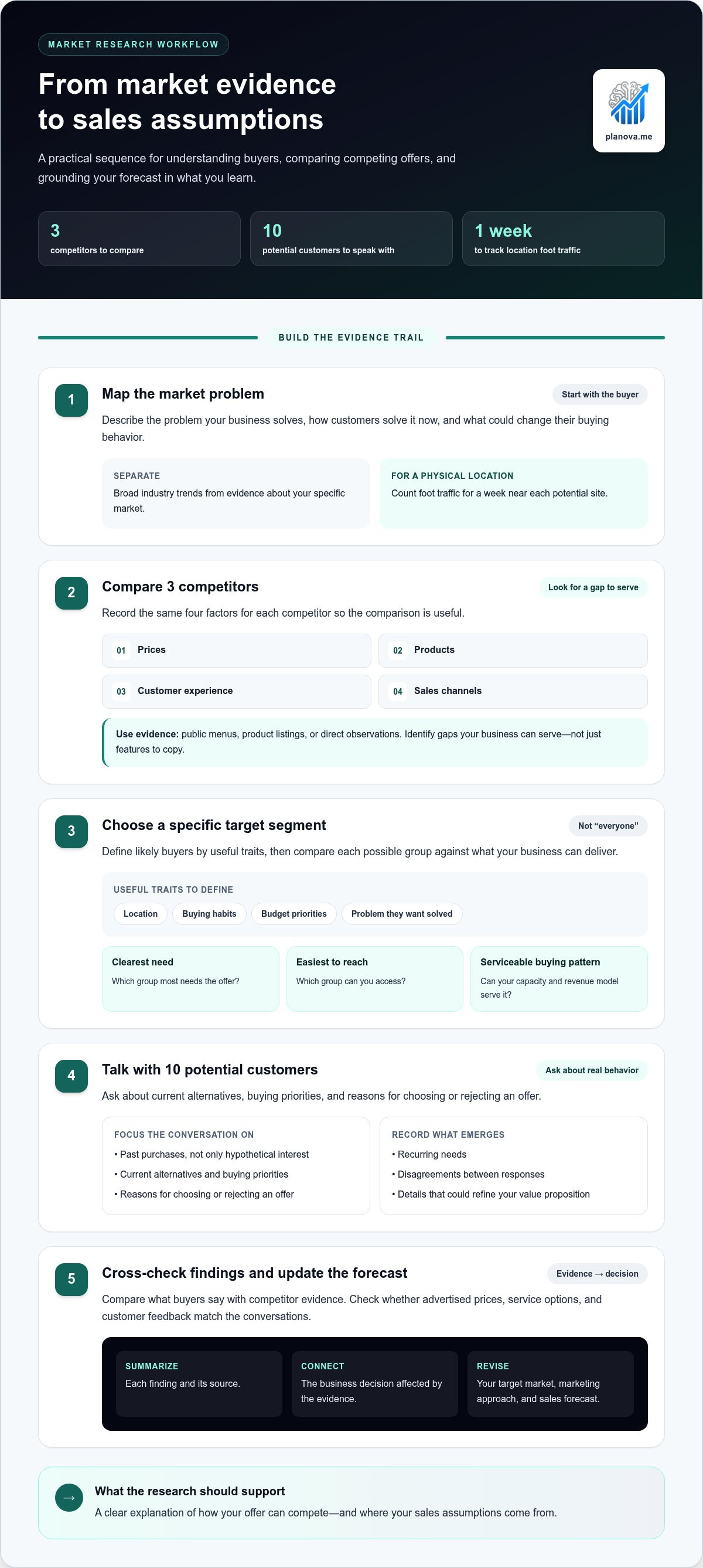
Map the industry before estimating demand. Describe the problem your business solves, how customers solve it now, and what could change their buying behavior. Separate broad industry trends from evidence about your specific market. For example, a shop considering a second outlet could count foot traffic for a week near each potential location.
Compare three competitors by recording their prices, products, customer experience, and sales channels. Look for gaps your business can serve, not just features to copy. Support your conclusions with evidence such as public menus, product listings, or direct observations. This analysis helps explain how your offer can compete and where your sales assumptions come from.
Target-Market Selection
Choose the customers most likely to need your offer and pay for it. Define them using useful traits such as location, buying habits, budget priorities, or the problem they want solved. A local service might focus on residents within its practical travel area, while an online seller could group buyers by needs or purchase behavior.
Compare each possible segment with your capacity and revenue model. Identify which group has the clearest need, is easiest to reach, and has a buying pattern your business can serve. Make the choice specific enough to guide pricing, promotion, and sales decisions. Avoid describing your target market as “everyone.”
Target-Market Research
Test your chosen segment through direct conversations and observable behavior. Speak with ten potential customers about their current alternatives, buying priorities, and reasons for choosing or rejecting an offer. Ask about past purchases instead of relying only on hypothetical interest. Record recurring needs and disagreements, as both can help refine your value proposition.
Compare those answers with competitor evidence. Check whether advertised prices, service options, and customer feedback match what buyers describe. For a physical location, track relevant foot traffic for a week and note busy periods. Summarize each finding, its source, and the business decision it affects. Use the evidence to adjust your target market, marketing approach, and sales forecast.
Financial projections and business plan assumptions
Build projections from operating drivers, not hopeful totals. Connect expected sales to pricing, customer volume, and the capacity your business can deliver.
To write a business plan step by step, define the business model, document market evidence, set assumptions, and forecast revenue, expenses, and cash flow. Add operations, marketing, and financial sections so readers can see how your strategy works.
Make assumptions visible. If sales depend on repeat purchases, state the expected buying pattern and explain its basis. If costs change with order volume, show that relationship in the forecast. Compare each assumption with your customer research and competitor observations, then revise unsupported estimates before sharing the plan.
A five-year forecast can show how hiring, capacity, and sales growth may affect results over time. Build it from a detailed view of at least the next 12 months, then extend the same drivers across later periods. Use realistic scenarios, and explain which changes drive each outcome rather than presenting one precise-looking figure without context.
Tailor custom financial projections to your revenue streams, cost structure, and business stage. A retailer might forecast sales by product category and inventory needs; a service business could model billable work and staffing capacity. Keep assumptions consistent across the written plan and spreadsheet, so a lender can trace each projection to a business decision.
For an SBA loan, follow the lender’s requested format and connect every projection to a clear assumption. Include the requested business details, use consistent figures throughout, and explain how the funding supports planned operations. Requirements vary by application and lender, so structure the plan around the materials requested for your loan process.
Common self-writing risks include overstated revenue, overlooked expenses, and assumptions that don’t match operations. Test a lower-sales scenario and check whether the business can still cover its expected costs. A structured financial model can help organize assumptions and projections into a consistent working document.
Building sales, cost, and cash-flow forecasts
Build a sales forecast around how customers buy, not just a growth target. List each revenue stream, its price, expected sales volume, and the capacity needed to deliver it. For example, a service business can estimate revenue from available project work and realistic customer demand. Link every assumption to evidence, such as customer conversations or competitor pricing, and explain how the forecast supports your business vision.
Separate costs by how they behave. Direct costs rise with sales, while operating expenses support the business across its activities. A catering business, for example, would track ingredients against bookings and account separately for ongoing kitchen expenses. Include staffing, supplies, rent, software, and other costs relevant to your operation. Check each category against records and planned operations, so an accurate sales estimate doesn’t hide an incomplete picture of costs.
Cash flow depends on when money arrives and leaves, not just on whether projected sales exceed costs. Map customer payment timing alongside supplier bills, payroll, inventory purchases, and other commitments. A business can show revenue on paper yet face a cash gap if customer payments arrive after major expenses are due. Identify those timing gaps and show how the business will manage them in its forecast.
Ground your estimates in records. Before writing the plan, gather 6 to 12 months of bank statements and sales records. Use them to compare actual sales, recurring expenses, and payment patterns with your assumptions. For a new business without operating history, document the evidence behind each estimate, then test a lower-sales case and a higher-cost case. Investors can then see the drivers behind the forecast, the risks you’ve considered, and how you would respond if results differ from expectations.
Business plan software and templates
A template provides a clear foundation for business planning, while software can organize sections and connect written plans with forecasts. Choose based on your purpose, working style, and the level of detail readers need.
Software Versus Consultant
A template or software lets you build the plan yourself, revise assumptions, and keep the document aligned with your decisions. A consultant may provide external analysis and challenge ideas you could overlook. The right option depends on your experience, the complexity of your business, and the plan’s purpose. If you can research your market and explain your figures, structured software may be enough.
Compare tools by how well they organize your business model, market analysis, operations, and financial information. Check whether you can edit sections easily and present the result in a format suited to its audience. The U.S. Small Business Administration describes a lean startup business plan as typically one page long, while a traditional plan can run dozens of pages. Choose the format that meets the reader’s needs.
Self-Writing Costs
Writing the plan yourself doesn’t have one fixed cost. Your outlay depends on the tools you choose, the time needed for research and writing, and whether you pay for editing or financial-model support. A template may reduce formatting work, but it won’t replace validating assumptions or building a coherent forecast. Account for your time as well as direct expenses.
Start with a simple format if you need a working plan for internal decisions. According to the U.S. Small Business Administration, a lean startup business plan can take as little as an hour to make. A funding application may call for a more detailed document, supporting analysis, and careful consistency checks. Set aside time to review every section, confirm that figures align, and make the final plan easy to present. If you’re ready to turn your research into a structured document, create a business plan.
Planova: Business Plans
Planova offers a practical next step when your research and assumptions are ready to become a structured plan. Its AI-powered platform generates business plans, feasibility studies, and financial forecasts, bringing strategy and projections together in a working document.
Use Planova when a blank page or disconnected spreadsheets make it harder to organize your thinking. The platform also generates Excel financial models and structured pitch deck presentations. These documents can help you assess viability, communicate your strategy, and present your business clearly to readers such as lenders or investors.
You remain responsible for the evidence behind your assumptions and the decisions your plan supports. Start with your market findings, then use the generated materials to shape a coherent business case. Visit planova.me to create your business plan.
Turn Your Plan Into Your Next Decision
A business plan without a consultant can be more than a document for an application. Treat it as a working decision tool and revisit it when customer behavior, operating capacity, or priorities change. Each update helps you decide what to pursue, what to pause, and where to focus limited resources.
When you’re ready to move from a draft to a polished business case, Planova generates Business Plans, Financial Models, and Pitch Decks. Choose the format that matches your next step, whether you’re clarifying the strategy, developing the numbers, or preparing to present your idea.
Contact Planova about your business plan and take the next step with a clearer foundation. Your plan should keep pace with the business you’re building, so keep testing your assumptions and refining your direction as you learn.
Frequently Asked Questions
Is a business plan template enough?
A template is enough when you can fill every section with evidence and explain how the parts fit together. Writing a business plan without a consultant works best when the business model is straightforward and you can test your assumptions. If you rely on generic claims, struggle to connect decisions to figures, or are preparing a plan for an unfamiliar audience, add research or seek a focused review.
Should I still pay someone to review my plan?
A review can help when the plan will inform a major decision or reach readers who expect clear, consistent evidence. Before sharing it, ask a knowledgeable reviewer to flag unsupported claims, unclear explanations, and mismatches between strategy and projections. For example, a reviewer should be able to trace a proposed hire to the operational need and financial assumptions, not merely correct grammar.
What is the most important part of a business plan?
The most important part is the logic connecting customer need, your offer, and how the business earns revenue. A polished executive summary cannot compensate for a weak business case. Check that a reader can understand who will buy, why they would choose your solution, and what the business must do to deliver it. Those connections make the plan useful for decisions.
